
General

The 2026 Strait of Hormuz Crisis: Geopolitical Shockwaves and Global Economic Fallout
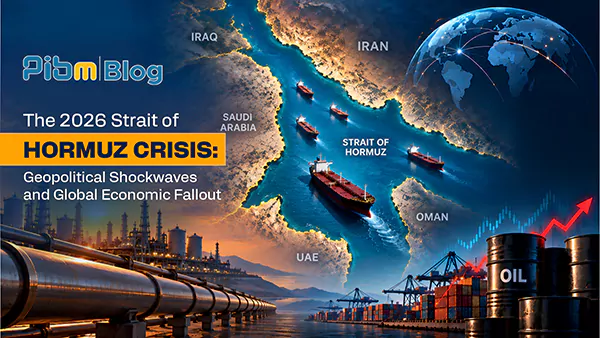
Table of Contents
Introduction: The Fragility of the Global Lifeline
As 2026 began, the global geopolitical environment was already shaped by strategic uncertainty, shifting alliances, and intensifying competition between the United States and China. Although the global economy initially remained resilient, supported by strong trade activity and growing artificial intelligence (AI) investments, this stability remained fragile. In March 2026, that vulnerability was dramatically exposed when the Strait of Hormuz, one of the world's most important maritime chokepoints, became the centre of an escalating military conflict.
The 2026 Strait of Hormuz Crisis extended far beyond regional political tensions, creating immediate repercussions for the global economy and putting the resilience of international supply chains and energy markets under severe pressure. With approximately 20% to 30% of the world's daily oil consumption moving through this narrow waterway, the disruption demonstrated how quickly a strategic chokepoint can affect global commerce. For business leaders, policymakers, and economic analysts, the crisis offers more than a geopolitical case study - it highlights the growing importance of risk management, strategic forecasting, supply chain resilience, and economic preparedness in an increasingly uncertain world.
Anatomy of the Crisis: Timeline and Escalation
The conflict erupted in early March 2026 and quickly escalated into a multifaceted maritime and aerial crisis. According to International Monitoring Agencies and Maritime Intelligence, over 50 commercial vessels - ranging from oil tankers to container ships - were attacked, damaged, or captured between March and July 2026.
The tactics deployed varied, from the use of naval mines and drone swarms to direct interventions by heavily armed fast-attack crafts. Prominent vessels, such as the chemical tanker Stolt Magnesium, the oil tanker Safesea Vishnu, and the container ship MSC Epaminondas, found themselves in the crosshairs of this escalating conflict.
In response to the severe disruption of commercial tanker passage - which effectively dropped to zero by early March as Protection and Indemnity (P&I) clubs pulled war risk coverage - a coalition of international forces mobilized. The United States led an intensive aerial campaign against strategic targets along the strait, instituted a naval escort operation to protect remaining maritime traffic, and eventually established a naval blockade. This period also saw frantic diplomatic maneuverings, including the drafting of the "Islamabad Memorandum" and the proposed formation of a Persian Gulf Strait Authority aimed at mediating the crisis and restoring navigational freedom.
Global Economic Shockwaves: The Data
The economic ramifications of the 2026 Strait of Hormuz Crisis were instantaneous and profound. As highlighted in the United Nations Conference on Trade and Development (UNCTAD) May 2026 Trade and Development Foresights report, the global economy faced a severe geopolitical challenge that threatened to derail post-pandemic recovery efforts.
| Economic Metric | Pre-Crisis (Jan-Feb 2026) | Crisis Peak (Mar-May 2026) |
|---|---|---|
| Global Oil Prices | Baseline Stabilization | +60% Surge |
| Natural Gas Prices | Baseline Stabilization | >100% Increase (Doubled) |
| Emerging Market Equities | Stable Growth | -12% Drop |
| Maritime Freight Risk Premium | Standard Rates | Historically High |
The most immediate impact was felt in energy markets. Within weeks of the outbreak, global oil prices surged by more than 60%, while natural gas prices more than doubled. This energy shock triggered a massive spike in global inflation and severely tightened financial conditions worldwide.
The crisis also wrought havoc on global financial markets. Emerging market equities plummeted by over 12% between late February and late March 2026. Furthermore, external sovereign bond yields spiked for both emerging and frontier-market economies, reflecting the growing anxiety among global investors.
Impact on the Global South: Vulnerability Exposed
Impact of the Crisis on Developing Economies
- Disproportionate Impact on the Global South: While advanced economies faced rising inflation, developing countries experienced greater economic pressure due to their dependence on imported fuel, fertilizers, and essential food commodities.
- Rising Energy Costs: The sharp increase in energy prices, combined with severe supply chain bottlenecks, placed significant pressure on government finances and foreign exchange reserves.
- Currency Depreciation: Currencies across several developing economies weakened considerably against the US dollar as investors moved their capital toward safer assets.
- Emergency Government Measures: Countries including India, Bangladesh, Egypt, Brazil, and Indonesia introduced emergency measures to manage the growing economic strain. These included:
- Capping domestic fuel prices
- Rationing energy supplies
- Intervening in currency markets to limit depreciation
- High Fiscal Cost: Although these measures can provide short-term relief, they place a substantial burden on government finances and fiscal resources.
- Greater Vulnerability of Frontier Markets: According to a UNCTAD report, frontier-market economies are especially exposed to prolonged conflicts because they typically have smaller and less liquid financial markets.
- A Global Geopolitical Reality: The crisis demonstrated how, in an interconnected global economy, disruption at a distant strategic chokepoint can have serious economic consequences for countries thousands of miles away.
Strategic Rebalancing: The Imperative for Clean Energy and Autonomy
Strategic Shifts Triggered by the Strait of Hormuz Crisis
- Energy and Supply Chain Security: Beyond immediate economic and logistical disruption, the 2026 Strait of Hormuz Crisis has prompted a broader strategic rethink. It highlighted the risks of excessive dependence on fossil fuels and highly concentrated supply chains, making energy diversification a national and economic security priority.
- Clean Energy as a Security Imperative: Renewable energy is increasingly being viewed not only as an environmental sustainability solution but also as a means of strengthening national energy independence and reducing vulnerability to geopolitical disruptions.
- UNCTAD's Recommendations: The UNCTAD report called for faster adoption of renewable energy and greater localization of critical industrial production, including semiconductors and high-performance batteries, to reduce dependence on vulnerable global supply networks.
- Unequal Clean Energy Investment: Despite Africa possessing 60% of the world's best solar resources, the continent attracted only 2% of global clean energy investment in 2024. Addressing this investment gap will be essential to developing a more resilient and equitable global energy system.
- Rise of Strategic Ambiguity: The crisis has also strengthened the trend of "strategic ambiguity" among middle powers. As tensions between major powers intensify, smaller nations are increasingly avoiding exclusive alignment with a single geopolitical bloc.
- Flexible Global Partnerships: Instead of committing fully to one side, middle powers are pursuing flexible and transactional relationships that allow them to protect their sovereignty, economic interests, and strategic independence.
Conclusion: A Fragmented Future
The 2026 Strait of Hormuz Crisis has highlighted the vulnerabilities embedded within the global economic system. It demonstrated how quickly geopolitical tensions can disrupt energy markets, increase living costs, and create economic instability far beyond the region where a conflict occurs.
For students and future business leaders at PIBM, the crisis offers important lessons about navigating an increasingly unpredictable business environment. Tomorrow's managers will have to deal with geopolitical volatility, supply chain disruptions, and the growing strategic importance of trade routes. Building corporate resilience will require more than an understanding of macroeconomic trends; it will also demand quick decision-making, strategic foresight, and the ability to respond effectively to unexpected geopolitical shocks.
Looking ahead, the global economic order is becoming increasingly multipolar and fragmented. Organizations that can understand this evolving landscape, invest strategically in emerging technologies and sustainable energy, diversify their operations, and maintain sufficient flexibility will be better prepared to navigate persistent uncertainty. In this environment, resilience and adaptability will become essential components of long-term business success.


Related Articles