
MBA / PGDM

The Silent Revolution of Tokenization & Fractional Asset Ownership
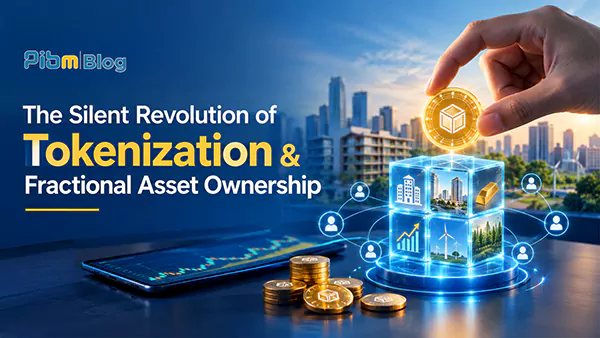
Table of Contents
- Can You Own a Fraction of Everything?
- First, What Is Being Tokenized?
- Why Fractional Ownership Changes the Conversation
- Tokenized Real Estate: Smaller Portions of a Big Asset
- Tokenized Bonds: Efficiency and Practical Case Study
- Tokenized Stocks: Ownership Needs to Be More Than a Screen Image
- The Management Perspective: From Promise to Real-World Adoption
- Before Purchasing Any Token: Five Key Questions to Ask
- Conclusion: Access Is Valuable, but Trust Is the Product
Can You Own a Fraction of Everything?
Real estate can be difficult to access because of its high cost, while bonds may also require a significant initial investment. Stocks are easier to purchase, but their transaction and settlement systems still rely largely on traditional financial market infrastructure. Tokenization introduces a different possibility: what if ownership in assets such as property, bonds, or other investments could be divided into smaller units and securely recorded on a shared digital ledger?
However, tokenization does not mean that every asset will suddenly become accessible to everyone. Its real potential lies in transforming how ownership claims are issued, recorded, transferred, and settled. When designed with appropriate safeguards, tokenization can improve accessibility, reduce transaction friction, and bring greater transparency to asset servicing. But if implemented poorly, it could simply place a sophisticated digital interface over assets that remain illiquid, complex, or risky. For management students, the key lesson is to look beyond the technology itself and understand the business model, underlying asset, risks, and enforceable rights that give tokenization its real value.
First, What Is Being Tokenized?
The token is a digital instrument of proof in a blockchain or any other Distributed Ledger Technology (DLT). The token could represent a certain asset, a contractual claim, or a share of ownership rights. Blockchain technology enables the parties to create an immutable shared history of which party owns which asset. Automated smart contracts may enable coupon distribution or impose other limitations on token use.
However, the token is not some kind of miracle. The relationship between the token and its actual underlying asset must be legally enforceable. For instance, if a token represents a share of a Special Purpose Vehicle (SPV) which owns a building, it doesn't necessarily entitle the owner of this token to one physical brick of that building.
Why Fractional Ownership Changes the Conversation
Fractional ownership involves dividing an asset into smaller economic slices. This may reduce the required minimum investment and help investors diversify rather than committing all their capital to one illiquid asset. The possibilities are compelling, especially in markets where younger investors face high capital entry barriers.
- Reduced barriers to entry: Investors may invest with a reduced ticket size.
- Wide distribution: Issuers may target a broader pool of qualified and verified investors.
- Programmable management: Income distribution and regulatory compliance checks can be automated via smart contracts.
- Audit trail improvement: A shared ledger makes reconciliation and audit tracking seamless for authorized parties.
However, having fractions does not automatically guarantee liquidity. A thousand token owners do not instantly create a buyer. True liquidity requires active market making, standard disclosures, secure custodianship, robust settlement rules, and adequate trading volume.
Tokenized Real Estate: Smaller Portions of a Big Asset
Real estate is one of the clearest examples of how blockchain and tokenization can change the way people access investments. Traditionally, buying property requires substantial capital, making it difficult for smaller investors to participate.
With tokenization, the structure works differently. An office building, warehouse, or student housing project can be placed under a Special Purpose Vehicle (SPV). The SPV can then issue digital tokens that represent specific economic rights associated with the asset, such as:
- A share of rental income
- Potential capital appreciation
- Other defined economic benefits linked directly to the property
This approach creates access to real estate investments without requiring the underlying physical property itself to be partitioned.
Why Tokenized Real Estate Matters
One of the biggest advantages is diversification. Instead of investing a large amount in a single apartment or commercial property, an investor can spread smaller ticket sizes across multiple asset classes and locations.
For developers, tokenization expands the potential investor base by allowing broader participation with accessible ticket sizes. However, tokenization does not eliminate the fundamental operational challenges of real estate. Many critical risks and processes remain off-chain:
- Property valuation: Determining whether the asset is fairly priced in the market.
- Tenant screening: Assessing creditworthiness and tenant reliability.
- Title verification: Confirming clean legal ownership and unencumbered property rights.
- Maintenance & repairs: Managing ongoing physical upkeep and property management.
- Taxes and regulatory compliance: Handling municipal taxes, transfer fees, and legal obligations.
- Exit and secondary resale: Finding buyers and executing smooth secondary market transactions.
Blockchain improves how ownership records are maintained, but it cannot replace proper due diligence. A poorly located or overvalued asset does not become a good investment simply because it has been tokenized.
Tokenized Bonds: Efficiency and Practical Case Study
As structured financial instruments, fixed-income bonds are naturally suited for tokenization. A tokenized bond encapsulates principal repayment terms, coupon schedules, maturity dates, and transfer rules. Tokenization enables a faster issuance cycle, real-time registry updates, and Delivery-versus-Payment (DvP) atomic settlement mechanisms.
Practical adoption is already underway in major global capital markets:
- In February 2023, the government of Hong Kong issued HK $800 million in tokenized green bonds.
- In February 2024, Hong Kong expanded this with a multi-currency issuance totaling approximately HK $6 billion across four distinct currencies.
While promising, the Bank for International Settlements (BIS) notes that tokenized government bonds require comprehensive coordination across regulatory bodies, central banks, and market infrastructure providers before reaching full institutional scale.
Tokenized Stocks: Ownership Needs to Be More Than a Screen Image
Tokenized equities represent a critical asset class. A token may represent direct equity ownership, a depositary-style security (DR), or merely synthetic economic price exposure. Investors must understand the distinction by evaluating key parameters:
- Do token holders hold shareholder voting privileges?
- Are token holders entitled to corporate dividend disbursements?
- What is the regulated legal entity backing the issuance?
- Can tokens be redeemed for the underlying public stock certificates?
- Which regulatory body oversees the secondary trading platform?
Compliance in tokenized equities is strategic rather than merely administrative. Securities laws, investor suitability norms, prospectus disclosures, and qualified custody remain foundational.
The Management Perspective: From Promise to Real-World Adoption
A study conducted by McKinsey projected that the value of tokenized financial assets could reach $2 trillion by 2030 in a base-case scenario (with projections ranging between $1 trillion and $4 trillion). However, realization depends on solving concrete operational bottlenecks:
- Accelerating settlement cycles (moving toward instant T+0 settlement)
- Lowering reconciliation overhead by automating corporate actions
- Streamlining cross-border collateral mobility
- Structuring compliant, institutional-grade financial instruments
For a PGDM student, the essential question is not whether blockchain will eliminate traditional banking institutions, but rather:
"Where can distributed ledger technology create meaningful value for financial stakeholders?"
The Future: A Hybrid Financial Architecture
The emerging consensus points toward a hybrid model where traditional institutions manage identity, custody, regulatory oversight, and dispute resolution, while DLT handles automated settlement, immutable record-keeping, and interoperable data exchange.
Before Purchasing Any Token: Five Key Questions to Ask
- Rights: What rights does the token entitle me to - equity ownership, revenue share, voting, or purely price exposure?
- Underlying Asset: Who legally owns the underlying asset, and how is custody authenticated?
- Liquidity: Where and how can the token be liquidated in case of an immediate cash requirement?
- Costs & Taxes: What transaction fees, management expenses, and capital gains taxes apply?
- Regulatory Protection: Which regulatory authority oversees the platform and provides dispute resolution mechanisms?
Conclusion: Access Is Valuable, but Trust Is the Product
Tokenization provides a scalable foundation to democratize fractional asset ownership across real estate, debt, and equity instruments. Yet ownership is not defined solely by a token on a distributed ledger; it is defined by legal enforceability, investor protection, transparent asset servicing, and market liquidity.
The real financial revolution is not about turning every asset into speculative cryptocurrency - it is about modernizing the infrastructure of ownership. When powered by clear regulatory frameworks and institutional trust, fractional ownership becomes an inclusive, transformative financial tool.

Related Articles