MBA / PGDM

The Latest Marketing Trend of 2026 And Its Effect on Consumer Behavior
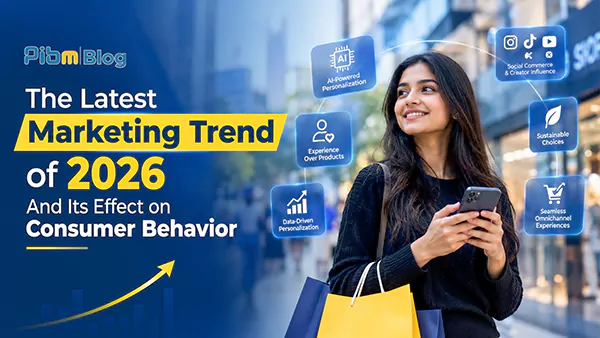
Table of Contents
- Introduction
- 1. Novelty to Infrastructure
- 2. Not a Differentiator: Personalization Has Become an Expectation
- 3. Strategy Has Gone Local as Attention Has Fragmented
- 4. Social Platforms Are Search Engines and Storefronts
- 5. Consumers' Trust Is the Ultimate Decider
- 6. In What Way Consumer Behaviour Is Responding
- Conclusion
Introduction
It is the speed of consumer trust, not the speed of campaigns, that influences the marketing of 2026. Certainly, the role of artificial intelligence has become the default engine behind content, targeting, and personalization, yet the brands pulling ahead are not the ones with the most up-to-date algorithms.
They are using the latest technology to say something more honest, more relevant, and more human than their competitors. The transformation cannot be viewed as a trend in a shallow sense; it is a recalibration of how marketing and consumer behaviour influence each other, built on countable changes in how a consumer discovers, evaluates, and pays for what they buy.
1. Novelty to Infrastructure
AI has evolved significantly and is now integrated into almost every part of the marketing stack, from generating multiple ad variations to creating content in real time. However, market performance ultimately depends on measurable results, not simply the volume of AI-generated output. The most effective approach is to use AI as an accelerator for human decision-making rather than a replacement for human judgement. According to IE University's 2026 digital marketing outlook, high-performing marketing teams are those that combine automation with strategic thinking, creativity, and human oversight instead of allowing AI models to make critical decisions independently (IE University, 2026).
A similar perspective emerges from the American Marketing Association's 2026 Future Trends report. The report suggests that while AI is likely to automate many transactional and repetitive marketing activities, human creativity, cultural understanding, and authentic storytelling will continue to distinguish successful brands (American Marketing Association, 2026). Therefore, businesses should evaluate AI adoption not simply by measuring how much content the technology can generate, but by assessing how effectively it saves strategic time and enables marketers to focus on decisions that require human insight, context, and judgement.
2. Not a Differentiator: Personalization Has Become an Expectation
Far from being impressed by personalization, consumers now assume it. According to IE University's 2026 research, 75% of consumers are more likely to buy from brands that deliver personalized content (IE University, 2026). Separately, Netguru's 2026 consumer behaviour analysis found that AI-driven recommendations can lift conversion rates by as much as 70%.
Yet only 41% of consumers believe personalization's benefits actually justify its privacy costs (Netguru, 2026). That gap is the single biggest risk in modern marketing: over-personalizing without transparency erodes exactly the trust it was meant to build. The market reflects a clear tension at the heart of this trend: a strong appetite for relevant experiences, alongside real hesitation about how that relevance is achieved.
3. Strategy Has Gone Local as Attention Has Fragmented
It is no longer realistic to reach a mass audience through a single channel. Deloitte Digital's 2026 marketing trends report describes an environment where consumer attention is split across AI-driven search, retail media, creator ecosystems, and niche communities, pushing brands to orchestrate many small, culturally relevant touchpoints instead of single broad campaigns (Deloitte Digital, 2026). Deloitte recommends identifying no more than three "must-win" channels per audience segment and adapting one consistent narrative across them, rather than reinventing messaging for every platform.
This same fragmentation is reshaping community behaviour. Kantar's 2026 research found that nearly 40% of consumers trust recommendations from micro-communities almost as much as evidence from friends, and that brands active in knowledge-sharing micro-communities achieved 25% higher marketing ROI than those relying on broad-reach campaigns (Kantar, 2026).
4. Social Platforms Are Search Engines and Storefronts
Nowadays, discovery increasingly begins on social platforms rather than search engines, with traditional search used afterwards mainly to validate a decision already shaped by content and community. Netguru's 2026 outlook projects that social commerce will account for more than 17% of global online sales in 2026, with US livestream shopping alone approaching $50 billion (Netguru, 2026). Shopping, in other words, is no longer a separate activity from browsing - it has become part of the entertainment feed itself.
5. Consumers' Trust Is the Ultimate Decider
Consumer trust in digital spaces is under real strain owing to AI-generated content, deepfakes, and misinformation spread. Deloitte Digital frames this as an erosion of "digital trust" that now sits at the center of brand strategy, not at the periphery (Deloitte Digital, 2026). Qualtrics' 2026 Global Consumer Experience Trends report adds a practical dimension: trust and satisfaction peak not when price drives a purchase decision, but when quality and service do - meaning the cheapest option is rarely the most trusted one (Qualtrics, 2026).
6. In What Way Consumer Behaviour Is Responding
Shifts in marketing dynamics are reactions to real changes in how people spend. Experian's 2026 consumer insights describe a shopper who is shopping more frequently but buying fewer items per trip - a sign of tighter, more deliberate budgeting rather than reduced brand engagement (Experian, 2026). Numerator's 2026 Visions report found that 37% of US consumers now cite rising prices as their top financial concern, up sharply from mid-2025 (Numerator, 2026).
Yet caution has not eliminated indulgence. Kantar's research found that 36% of consumers are willing to take on short-term debt to spend on things they enjoy - a pattern researchers describe as "treatonomics", where small, affordable joys substitute for larger purchases people are postponing (Kantar, 2026). At the same time, Quirks' coverage of the 2026 "What Matters" global study found that 54% of consumers globally feel that fashion, content, and culture are starting to look the same, fueling a countertrend of "human pride" - a renewed appetite for craft, imperfection, and individuality in the products and brands people choose (Quirks, 2026).
Conclusion
In 2026, consumers want brands to understand them without compromising authenticity or privacy. While AI, social commerce, and hyper-personalization are transforming marketing, trust, transparency, and human judgement remain essential for building lasting customer loyalty. The brands that succeed will be those that use technology thoughtfully to create relevant, genuine experiences rather than simply increasing automation. Technology may capture attention, but human connection turns that attention into loyalty.


Related Articles