
MBA / PGDM

When Borders Enter the Boardroom: Geopolitics, AI, Supply Chains, and Strategic Competition
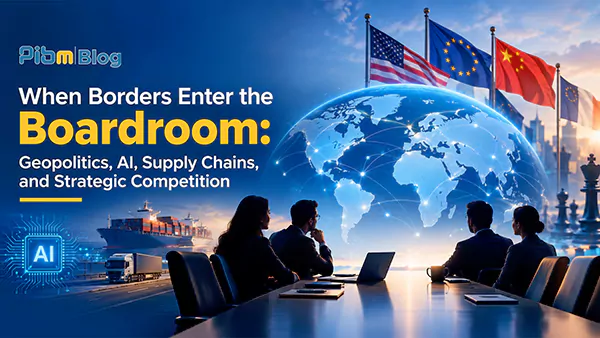
Table of Contents
How Geopolitics Is Redefining Global Business in the Age of AI, Supply Chains, and Strategic Competition
For many years, globalisation created a world in which goods, capital, technology, and ideas could move across borders with greater ease. Businesses focused on maximizing efficiency, consumers benefited from competitive prices, and economies became more connected than ever before. However, the same global networks that accelerated economic growth have also increased the world's exposure to geopolitical disruptions.
Today, a conflict in one part of the world can interrupt supply chains thousands of miles away, while a single policy decision can influence billion-dollar investments almost overnight. Strategic resources such as semiconductors have become as critical to global power and business competitiveness as oil has been for decades. This blog examines how geopolitics has moved beyond diplomacy to become a key driver of business strategy, supply chains, investment decisions, and corporate leadership in an increasingly uncertain global economy.
The Day a Ship Changed Course - and the World Took Notice
On a winter morning in early 2024, a cargo vessel carrying thousands of containers altered its planned route. Instead of passing through the Suez Canal - the shortest maritime link between Europe and Asia - it began a journey around the Cape of Good Hope, adding thousands of kilometres and several days to its voyage.
At first glance, it seems like just another maritime update. Yet, that single decision can delay factory production in Europe, disrupt inventories in Asia, increase freight costs for manufacturers, and ultimately raise prices for consumers thousands of kilometres away. What appears to be a regional conflict quickly becomes a global business problem.
This is the world in which businesses operate today. For decades, globalization encouraged companies to think beyond borders. Production was shifted to wherever costs were lowest, technology flowed across continents, and supply chains stretched from Silicon Valley to Shenzhen with remarkable efficiency. A smartphone purchased in India might contain a processor designed in California, manufactured in Taiwan using Dutch lithography machines, assembled in Vietnam, and shipped through Singapore before reaching the customer. Geography seemed to matter less than economics.
That assumption has quietly changed. Today, business leaders are discovering that geography never disappeared - it merely hid.
From Efficiency to Resilience
For nearly three decades, businesses optimized for one goal: Efficiency. Lean inventories, just-in-time manufacturing, and globally dispersed supply chains helped companies reduce costs and maximize profits. The model worked because the world appeared relatively stable.
Then came COVID-19. The pandemic was more than a health crisis - it became the world's largest supply-chain stress test. According to the World Trade Organization (WTO), global merchandise trade contracted by 5.3% in 2020, while shortages of semiconductors forced automobile giants such as Ford, Toyota, and General Motors to temporarily halt production. Billions of dollars in revenue were lost because one tiny electronic component was unavailable.
It was a striking reminder that in a hyper-connected economy, the absence of a single component can stop an entire production line.
Before global supply chains had fully recovered, another disruption followed. Russia's invasion of Ukraine unsettled energy and commodity markets, while attacks on commercial vessels in the Red Sea forced shipping companies such as Maersk and Hapag-Lloyd to reroute vessels around the Cape of Good Hope. Since nearly 12% of global trade normally passes through the Suez Canal, longer routes meant higher transportation costs, delivery delays, and increased insurance premiums.
None of these events originated in corporate boardrooms. Yet every one of them ended up on the boardroom agenda. The lesson was unmistakable: the most efficient supply chain is not always the most resilient one.
When Technology Became a Strategic Asset
If oil shaped the geopolitics of the twentieth century, semiconductors are shaping the twenty-first. Every breakthrough in artificial intelligence begins long before an algorithm is trained. It begins inside a semiconductor fabrication plant.
Semiconductors: The New Strategic Asset in Global Business
- AI Depends on Advanced Semiconductors: AI applications across healthcare, finance, education, manufacturing, and scientific research rely on advanced chips capable of performing trillions of calculations every second.
- Key Industry Leaders: NVIDIA designs high-performance AI processors, while TSMC (Taiwan Semiconductor Manufacturing Company) manufactures the majority of the world's most advanced semiconductor chips.
- Semiconductors Are More Than Commercial Products: Advanced chips have evolved from being technology products to becoming critical strategic assets for economic growth, innovation, and national security.
- US-China Technology Rivalry: The growing competition between the United States and China has turned semiconductors into a geopolitical priority.
- Trade Policies Have Become Strategic Tools: Export controls, licensing requirements, and restrictions on advanced AI chips are now used as instruments of geopolitical strategy rather than conventional trade policy.
- Global Ripple Effect of Policy Decisions: A policy decision in Washington can influence investment decisions in Bengaluru, manufacturing strategies in Taiwan, and domestic innovation efforts in Beijing.
- Technology and Diplomacy Are Now Connected: The future of technology is increasingly shaped not only by engineering and innovation but also by diplomacy, international regulations, and geopolitical relationships.
- NVIDIA as a Real-World Case Study: As global demand for AI processors increased, NVIDIA had to balance commercial opportunities with evolving government export restrictions, making market access as important as technological innovation.
The question for businesses has therefore changed. It is no longer simply: "Can we build the best technology?" It is increasingly: "Can we continue doing business if the rules change tomorrow?"
When Risk Became Strategy
For decades, businesses built their strategies around predictability. Long-term supplier contracts, centralized manufacturing, and five-year expansion plans were seen as the foundation of sustainable growth. Today, that business environment has changed. Uncertainty has become a strategic reality, and companies are expected to prepare for disruptions that can emerge overnight.
Instead of focusing only on cost and efficiency, business leaders are now asking different questions: What happens if a supplier is sanctioned? What if a major trade route is disrupted? What if export policies change without warning? This shift shows that geopolitics is no longer separate from business strategy - it has become a core part of it.
How Business Strategy Has Changed:
- Resilience over efficiency: Companies are prioritizing business continuity instead of optimizing only for the lowest cost.
- Supplier diversification: Businesses are reducing dependence on a single supplier or country by expanding sourcing across multiple markets.
- Regional manufacturing hubs: Organizations are building production facilities closer to key markets to reduce geopolitical and logistics risks.
- Higher inventory buffers: Many companies are maintaining additional inventory to absorb unexpected supply chain disruptions.
- Scenario planning: Instead of relying on one long-term forecast, businesses are preparing for multiple geopolitical and economic scenarios.
Apple and the Rise of "China Plus Many"
A strong example of this transformation is Apple. For years, China was the backbone of Apple's global manufacturing network. However, rising geopolitical tensions and repeated supply chain disruptions encouraged the company to expand production into India and Vietnam. China remains an important manufacturing base, but spreading operations across multiple countries embodies the transition from "China Plus One" to "China Plus Many" to improve resilience.
A New Philosophy of Globalization
This shift represents a major change in the way globalization is viewed. The objective is no longer to build the cheapest supply chain possible. The new priority is to build a resilient, flexible, and geographically diversified supply chain that can continue operating even when geopolitical tensions, trade restrictions, or global disruptions affect one part of the world.
India's Moment in the Global Economy
Every major shift in the global economy creates new winners. Today, India finds itself at one of those defining moments.
As multinational companies diversify beyond traditional manufacturing hubs, India is increasingly being viewed not only as one of the world's largest consumer markets but also as a strategic production and innovation destination. Initiatives such as the Production Linked Incentive (PLI) Scheme, the India Semiconductor Mission, and growing investments in electronics manufacturing signal the country's ambition to become an integral part of global supply chains.
Recent developments reflect this momentum. Companies such as Apple have expanded iPhone assembly in India, while projects like the Tata Electronics-PSMC semiconductor fabrication plant represent India's long-term ambition to participate in advanced semiconductor manufacturing.
Yet opportunity alone does not guarantee success. Countries such as Vietnam, Malaysia, and Mexico are also attracting global manufacturers by strengthening infrastructure, improving logistics, and developing skilled workforces. The competition is no longer simply about offering lower costs; it is about providing reliability, policy stability, and the confidence businesses need to make investments that will last decades.
For India, therefore, the challenge is clear: the world is looking for resilient partners. The countries that combine infrastructure, skilled talent, consistent policies, and strategic vision will emerge as the preferred destinations in the next phase of globalization.
The New Rule of Global Business
Perhaps the most important lesson from the past few years is that globalization has not ended - it has evolved.
International trade continues to connect economies. Technology continues to accelerate innovation. Digital platforms continue to shrink distances between markets. But increasing interconnectedness has also made businesses more vulnerable to geopolitical shocks.
The world has become so interconnected that distance no longer protects businesses from disruption. As a result, boardrooms today discuss far more than customers, costs, and competitors. Conversations increasingly include supply-chain resilience, cybersecurity, technological sovereignty, sanctions, and geopolitical risk.
As Lord Palmerston famously observed, "Nations have no permanent friends or allies; they only have permanent interests." That insight is just as relevant in today's corporate world. Companies may not choose the geopolitical environment in which they operate, but they must learn to navigate it wisely.
Ultimately, the story of fractured supply chains, semiconductor rivalries, and shifting alliances is not merely about trade or technology. It is about a fundamental transformation in how businesses create value and manage risk.
The businesses that succeed in the next decade will be those that can anticipate disruption, respond with agility, and build resilience in an increasingly uncertain world. Competitive advantage is no longer determined only by larger factories, advanced technology, or lower costs. It is increasingly shaped by an organization's ability to understand changing geopolitical dynamics and adapt its strategy accordingly.
For future managers and business leaders, success will depend on looking beyond markets and financial metrics to understand the broader global environment. In today's interconnected economy, where nations are driven by permanent interests rather than permanent alliances, geopolitical intelligence has become just as important as business intelligence. Organizations that combine strategic foresight with global awareness will be better positioned to navigate uncertainty and create long-term value.


Related Articles