
MBA / PGDM

The 2026 Decarbonisation Paradox: Tech Progress vs Climate Reality
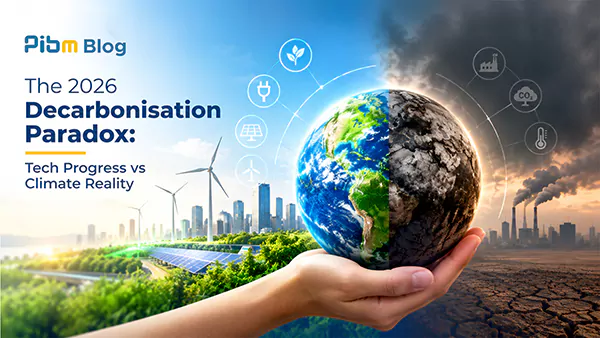
Table of Contents
The Paradox at the Heart of the Climate Story
Trying to follow climate news in 2026 can be exhausting. One day it is a new ESG term, the next it is another record-breaking climate chart or a company announcing a net-zero target. With so much information coming at us, sustainability can sometimes feel like a boardroom conversation far removed from everyday life. It isn’t.
Climate and sustainability decisions are already finding their way into our daily lives. They can affect what we pay for essentials, how secure our long-term savings are, which industries create jobs, and even the quality of the air our children will breathe.
This brings us to what can be called the Decarbonisation Paradox. The world is adding clean-energy capacity at a remarkable rate, yet global carbon emissions continue to hit record levels. The irony is hard to ignore: the solutions are becoming more available, but progress is still not happening fast enough.
The real challenge, therefore, is no longer just inventing better technologies. We already have many of the tools needed for a cleaner future. What matters now is whether governments, businesses, investors, and communities can turn ambitious promises into consistent, measurable action at the scale the problem demands.
Winning the Tech War, Losing the Emissions Battle
The energy transition is arriving faster than the infrastructure needed to support it. Solar power capacity has tripled in just four years, yet global COâ‚‚ emissions reached 41 billion metric tons in 2025, the highest level ever recorded.
The balance of responsibility is also shifting. For the first time in nearly three decades, advanced economies saw faster emissions growth than emerging economies, a sign that the burden of the transition is moving. At the same time, China's emissions have begun to decline, evidence that the trend can turn, even if slowly. The technology exists; what is missing is the “plumbing†— the grids, battery storage, and political will needed to turn targets into results. The goals are still achievable — but only if we drop the excuses and start moving now.
The 92% Who Want to Invest Green — and the 31% Who Do
There is a growing gap between what people say they want and where their money actually goes. Surveys show that 92% of individual investors express interest in sustainable investing, yet only 31% currently hold meaningful allocations in green funds.
That gap is not a sign of public apathy; it reflects cynicism. Greenwashing risk has jumped 23% over the past year, leaving investors wary of distinguishing genuine environmental progress from marketing dressed in green. New regulatory standards in the EU are beginning to close that gap, introducing the transparency requirements people need to finally align their money with their values.
Where the World's Economies Actually Stand
The latest Climate Change Performance Index (CCPI) offers a blunt assessment of G20 progress: the top three positions on the ranking sit empty. Not a single country currently qualifies as a “very high†performer.
- Denmark (4th Place): Holds the highest rank worldwide, demonstrating what sustained investment in offshore wind can achieve.
- United Kingdom: Steadily climbing the global rankings on the strength of its coal phase-out.
- United States (65th Place out of 67): Ranks behind every other G20 economy, with only Iran and Saudi Arabia scoring lower.
The U.S. position illustrates what might be called a “perfection trapâ€: waiting for full political alignment instead of pursuing achievable progress. The cost of that inaction is not abstract. It shows up in higher energy bills, lost manufacturing opportunities, and rising insurance premiums driven by more severe weather.
From Perfection to Progress: A New Way to Measure Success
It may be time to retire the idea of “saving the planetâ€. The planet has weathered ice ages and mass extinctions and will continue regardless. What is actually at stake is our own well-being: our homes, our health, and our economies.
That reframing suggests a different standard: imperfect progress over unattainable perfection. A record 664 gigawatts of solar capacity was installed last year, proof that the technology race is being won. The next step is pairing that progress with the infrastructure to use it — smarter grids and better storage.
The human dimension of this progress is easy to overlook. Roughly 1 billion people have gained access to clean drinking water in recent years, and 1.2 billion have gained access to proper sanitation. ESG, once dismissed as a niche concern, has become a practical tool for managing risk: a company that ignores climate exposure is a company unprepared for inflation, supply chain disruption, and social instability.
The Choice in Front of Us
We are living through one of the biggest energy shifts in history. Solar power is becoming more affordable, electric vehicles are moving into the mainstream, and economic growth no longer has to come at the expense of the environment. What matters now is whether we are willing to act on that possibility.
2026 can be a turning point—not because everyone will suddenly agree, but because more people can start acting with the influence they already have. Our pensions, purchases, investments, and votes all send signals about the kind of future we want.
In the end, sustainability will not be shaped by a few people making perfect choices. It will be shaped by millions of ordinary decisions made consistently. In 2026, how we spend, save, and invest may be one of the clearest statements we make about the world we want to build.

Related Articles